

Strategic Stability · Horizon 2026–2030
The Yemen Escalation
A new front in the West Asia War
- By
- Vasudha
- Published
- 26 October 2026
- Horizon
- 2026–2030
- Pillar
- Strategic Stability
- Anchors
- New Delhi
- Reading time
- 5 minutes
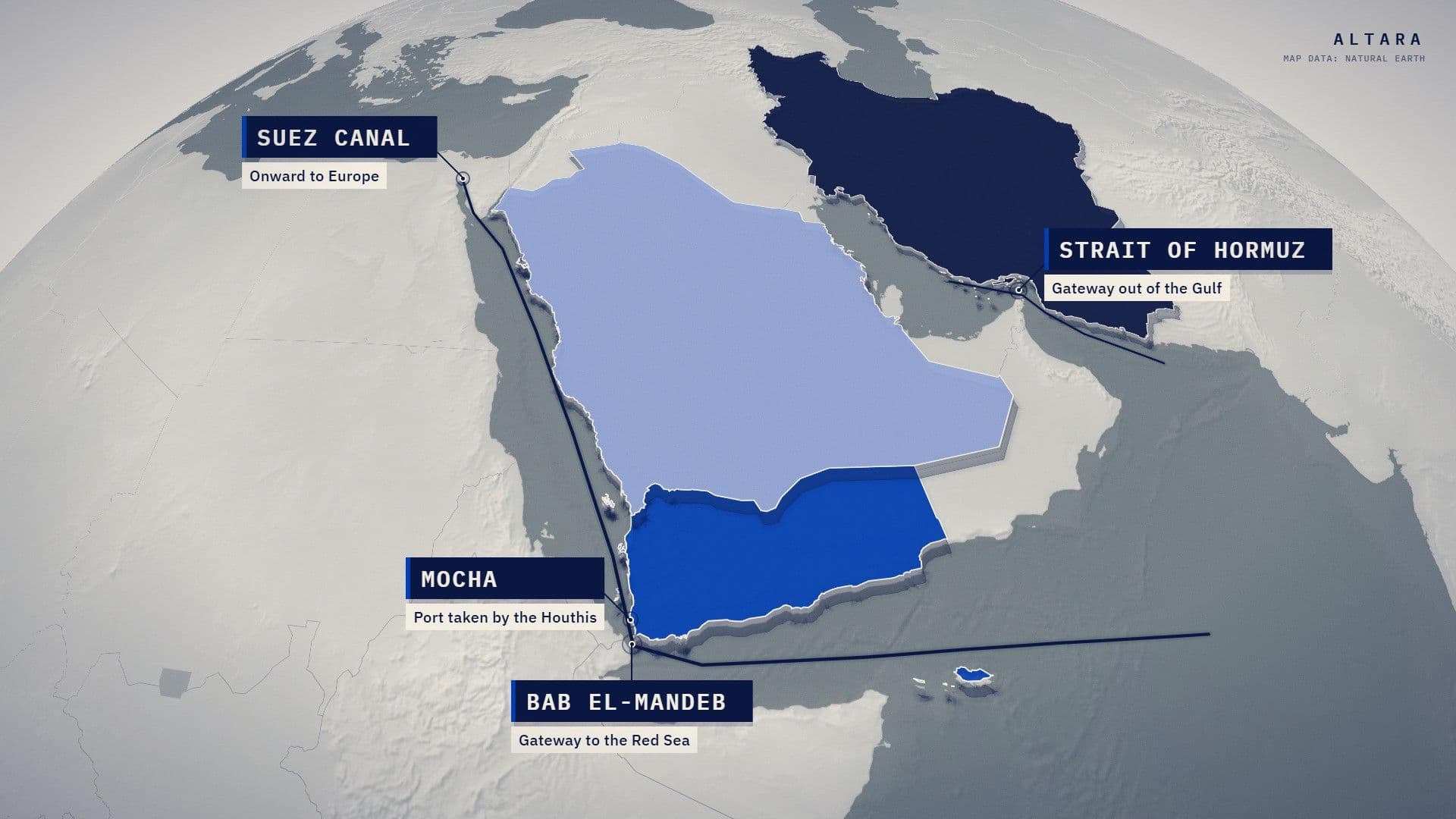
For years, the war in Yemen was seen essentially as a regional conflict, where the Houthis were fighting Yemen’s Saudi-backed government, with Iran and Saudi Arabia supporting opposite sides. But the picture has dramatically changed in the last few days. The Houthis have made a rapid advance along Yemen’s Red Sea coast and have captured important territory, including the port of Mocha and strategic islands around the Bab el-Mandeb Strait. At the same time, they have stepped up attacks on Saudi Arabia, while Saudi forces have responded with heavy strikes inside Yemen. These developments have raised concerns that Yemen’s conflict is becoming increasingly connected to the wider US-Iran confrontation.
Why does Yemen matter now?
Yemen sits at a very crucial geographical location. It borders the Bab el-Mandeb Strait, a narrow waterway connecting the Red Sea to the Gulf of Aden and the Indian Ocean. This is one of the world’s most important shipping routes, as ships travelling between Asia and Europe go through the Indian Ocean, Bab el-Mandeb, the Red Sea, and then the Suez Canal. This gives Yemen leverage, as whoever can threaten shipping through the Bab el-Mandeb has the ability to create problems far beyond the area around it.
The Houthis have now moved much closer to this strategic waterway. The recent offensive by them has given them a much stronger position overlooking Bab el-Mandeb and has alarmed Saudi Arabia and other regional powers. This is what makes the current crisis particularly significant, as developments along Yemen’s Red Sea coast could have consequences well beyond the country itself.
The Iran angle
The larger significance comes from Iran, as it is already at the centre of a major confrontation with the United States. The Houthis are not simply Iranian allies, but they are one of Iran’s most important regional partners, and Tehran has provided them with military and technological support. However, this support does not mean that Iran directly controls Houthi decisions or military operations. This gives Iran an important strategic advantage as it can put pressure on the United States and its allies from another part of the Middle East without necessarily fighting American forces directly in Yemen.
The strategic logic is increasingly clear. While Iran confronts the United States directly, the Houthis provide Tehran with another way to widen the pressure indirectly. By targeting Saudi Arabia, which is a key US partner in the region, and threatening shipping around the Red Sea, the Houthis are turning Yemen into a point of pressure that extends well beyond its borders. Any disruption to the Red Sea will affect global trade, energy supplies, and shipping costs, meaning that a conflict in Yemen can quickly acquire international consequences.
Iran’s geographical position gives it an enormous strategic advantage around the Strait of Hormuz, which is the gateway out of the Persian Gulf. Meanwhile, the Houthis are positioned near the Bab el-Mandeb, which is the gateway to the Red Sea. The two straits are not the same, and Iran does not directly control the Bab el-Mandeb. However, the strategic significance lies in the possibility of pressure on both ends of the Arabian Peninsula. One route affects energy coming out of the Gulf, and the other affects the movement of ships between Asia, Europe, and the Middle East. Disruption at both chokepoints could therefore create a much wider threat to global trade and energy supplies.
Saudi Arabia on the Frontline
Saudi Arabia is the country most directly affected by the latest developments. Riyadh is a close strategic partner of Washington and has spent years trying to reduce its involvement in Yemen after a long and costly war with the Houthis. But the latest Houthi attacks have pulled Saudi Arabia back into the conflict. The Houthis have launched missiles and drone attacks against Saudi territory and infrastructure. But for Riyadh, the problem is bigger than the Yemen border. A stronger Houthi presence on the Red Sea coast could threaten Saudi Arabia’s western coastline, oil infrastructure, and wider economic ambitions near the Red Sea.
The Houthis and the United States
Although the Houthi confrontation with Saudi Arabia is growing, the United States is not rushing into a direct war with the group. This is a significant move because Saudi Arabia is a key US partner, but Washington has taken a more cautious approach towards the Houthis. US officials met Houthi representatives in Oman in talks that maintained the US-Houthi ceasefire and prevent attacks on American shipping. The Houthis have indicated their agreement not to impact shipping through the Red Sea. And this has created an unusual situation because the Houthis are fighting Saudi Arabia-backed forces, threatening Saudi interests and strengthening their position around the Bab el-Mandeb Strait, while also maintaining communication with the US. Such engagement allows the Houthis to preserve a channel with Washington while focusing on their conflict with Saudi Arabia. For the US, the calculation is to protect navigation in the Red Sea without opening another war with Yemen.
The Real Danger: A Second Major Front
The bigger question is whether Yemen remains a contained conflict or becomes a full part of the wider Iran-US war. The conflict now sits at the intersection of several larger struggles: the US-Iran confrontation, regional security, tensions between Iran and Saudi Arabia, and the long-running conflict between the Houthis and Yemen’s Saudi-backed government.
The Houthis advance towards Bab el-Mandeb has increased Yemen’s strategic importance. The US is trying to prevent Yemen from becoming another indirect war with Iran’s allies. Saudi Arabia is trying to prevent the Houthis from becoming an even greater threat on its doorstep.
And Iran may gain another source of strategic pressure through its partnership with the Houthis, although the extent of its influence over their actions remains an important distinction.
The key point is not that Iran controls Yemen or that the Houthis are simply fighting America's war by proxy, but that the conflict is increasingly being pulled into the wider US-Iran war. The consequences could extend beyond the region, particularly if tensions disrupt shipping through the Strait of Hormuz or the Bab el-Mandeb Strait.
Conclusion
What began as a struggle involving the Houthis, Saudi Arabia, and Yemen’s internal political divisions is now tied to the wider confrontation between Iran, the United States, and their regional partners. The Houthis' position along the Red Sea gives them the ability to threaten a trade route that connects Asia with Europe, while their attacks on Saudi Arabia bring the interests of a key US partner directly into the conflict. Any prolonged disruption around the Bab el-Mandeb and the Red Sea could push ships towards longer routes around Africa, raising freight, insurance and energy costs and adding pressure to an already fragile global economy.
At the same time, the US's cautious engagement with the Houthis shows that Washington is trying to prevent Yemen from becoming an entirely new battlefield. The central challenge is therefore to prevent the conflict from widening into a broader regional confrontation, while protecting the shipping routes that are vital to global trade and energy security. What happens in Yemen may ultimately be measured not only in territory gained or lost, but in the cost of moving goods and energy around the world.
References
Next week’s paper, in your inbox
More research
Strategic Stability · Horizon 2026–2030
Borders Are Fixed, But Threats Aren’t
Rethinking the Meaning of Security
Geoeconomics & Supply Chains · Horizon 2035 and beyond
Computing Power
Data Centres as the New Battlefield of Great Power Competition