

Geoeconomics & Supply Chains · Horizon 2035 and beyond
Computing Power
Data Centres as the New Battlefield of Great Power Competition
- By
- Hemapriya
- Published
- 26 October 2026
- Horizon
- 2035 and beyond
- Anchors
- New Delhi
- Reading time
- 7 minutes
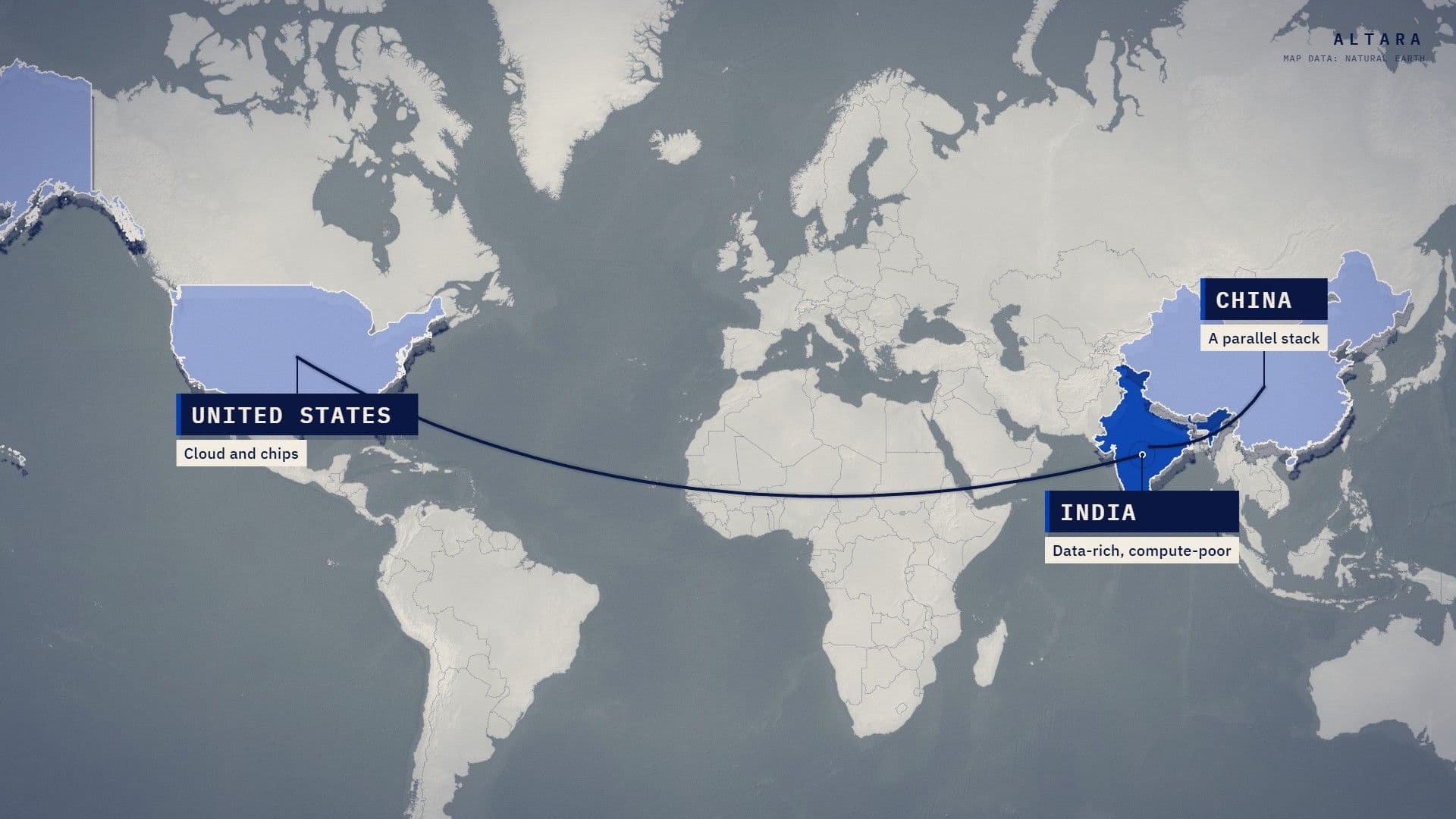
The data centre has evolved from being an archive of digital data to becoming the network that creates, concentrates, and distributes computing power. The emergence of AI has made these systems strategic assets by linking access to computational resources with technological strength, economic competitiveness, cybersecurity, and digital sovereignty. It means that data centers are no longer mere technical facilities but play a vital role in the digital economy, but they have data centres that serve as the basis for AI, cloud services, cybersecurity, and digital sovereignty, making these places important for global competition for power. For India, this poses the challenge of how it can grow its digital economy without letting its computing capabilities become a point of strategic dependence for the country.
Transformation of Data Centres
The progress has been slow but meaningful. Ten years ago, data centres were seen from an economic perspective: companies outsourced data storage and processing in order to save money. Companies like AWS, Microsoft Azure, and Google Cloud became the intermediaries of this process and gained their competitive advantage from efficient operations and scalability. However, this view ignores a more significant reality.
Today, data centres represent the physical embodiment of digital power. They are not just a neutral piece of technology. The location of data centres, who owns them, what kind of technology they use, or how resistant they are to failures determines who has access to computer power, what data is being processed where, and whose interests are represented in the digital economy. This explains why countries treat the issue of data centre construction as a political question, rather than just a commercial one.
Computing Hierarchy and AI
Pursuit of artificial intelligence capabilities has laid bare this transformation. Developing large language models and other cutting-edge AI systems depends on an enormous amount of computational power located at particular places across the globe. Therefore, the countries or companies managing these computing clusters hold true power in the sphere of artificial intelligence. Because China is unable to achieve state-of-the-art semiconductor production, it had to create unnecessary alternatives and set up the necessary data centres in the country.
This certainly leads to the emergence of a hierarchy. The countries that have access to cutting-edge data centres and semiconductors have the opportunity to develop advanced AI technologies. Others are in a subordinate position and use AI-based technologies by means of foreign companies’ Application Programming Interfaces(API) that are subjected to export restrictions. At this stage, India is in the latter category, being one of the AI consumers but not having enough computing power to develop them in the country.
Economic Dependencies and Cloud Computing
The transition toward utilising cloud-first systems has resulted in the development of dependent structures. Indian enterprises, start-up companies, and governmental organisations are increasingly relying on large-scale cloud computing companies such as Amazon Web Services, Microsoft Azure, and Google Cloud to meet their computation needs. This reliance is not troubling from a pure efficiency perspective; however, it may lead to vulnerabilities in service outages that can cause a chain reaction in the entire Indian economy.
Furthermore, the matter of data sovereignty is still an issue as sensitive government and private sector information transmitted through foreign infrastructure is raising legal dilemmas and operational risks.
The problem is not that foreign cloud services are untrustworthy, but rather that putting key infrastructures in foreign hands suggests asymmetric dependencies. Geopolitical tensions can lead to service limitations, pricing strategies, and forced data access through these cloud services.
Cyber security and resilience of infrastructure
Data centres serve a dual role in cyber operations as both targets and enablers. Malicious actors conduct advanced persistent threat campaigns to breach data centre systems and gain constant access to networks operated by hundreds of organisations. State-sponsored groups have targeted cloud storage companies to retrieve intelligence from data stored in cloud services or to build backdoors for future exploits.
The need for resilient infrastructure gets compounded by the fact that data centres are single points of failure. If an attack happens against a major data centre or a number of data centres clustered in a region, all networks critical for communications, finance, online shopping, and state functions are stopped at the same time.
India’s cybersecurity capabilities have improved significantly, but they are still dispersed, and most organisations do not have the necessary resources to fully invest in defence options. Most companies rely on the security measures of providers, which are reactive and not proactive.
In addition to this, India has little capability to audit security practices in foreign-owned data centres or guarantee that sensitive data gets privileged protection.
Digital Sovereignty: A Central Concern
Digital sovereignty is now a key aspect of data centre strategies for major nations. The concept includes multiple aspects: the capacity for processing data without foreign reliance, the ability to govern data transfer from one country to another, the independence of establishing standards of security, and the authority for regulating citizens’ data access.
China vigorously supported digital sovereignty through the development of parallel networks and the requirement of local data storage by foreign companies. The European Union used the General Data Protection Regulation (GDPR) and other regulations to claim authority over data transfers. The USA relied upon its exceptional position in the industry to put emphasis on the ability to operate in foreign markets while controlling essential technologies.
India's stance has been more reactive than strategic. Although it has rolled out data localisation mandates in targeted sections, there does not seem to be a clear design. The government has actively promoted local cloud service providers, but they have remained insignificant contenders against the American and Chinese giants in the industry. The government's initiative to create a National Cloud ended without much success. The fact is that despite being a data-rich country, it relies mostly on global protocols and is thus in a paradoxical position of being unable to take full advantage of its entire potential.
Geopolitical Aspects
Data centres, because they facilitate technological supremacy, economic conquest, and strategic independence, have emerged as venues for competition among major powers. The United States commands worldwide leadership in the cloud field, thus enabling itself to effectively dictate which countries can use cutting-edge technologies and the conditions of their access. China combines state ownership of most data centres with strict requirements for localisation and integration with surveillance systems so that its data centre strategy becomes closely related to domestic control systems.
Inadequately powerful countries, like India, have to choose between becoming dependent either on American or Chinese infrastructure, each of which has different geostrategic consequences, making investments in developing their own alternatives which will require huge amounts of capital as well as workforce, or creating a hybrid scheme that will connect local and foreign infrastructure with legislative policies.
Significance for India
India's issue is truly multi-faceted. From the economic standpoint, it appears that the development of the digital economy of the country, including e-commerce, fintech, and SaaS, requires the use of foreign cloud services. In this regard, pushing companies to turn to domestic alternatives may adversely affect operational costs and efficiency. However, from the strategic viewpoint, the dependency on foreign service providers creates certain areas for concern.
India’s policy strategy is also indicative of the economic significance that it places on increasing domestic data centre capacity. The Indian government, through the Union Budget 2026-27, made an announcement of giving a ten-year tax holiday till 2047 for data centre companies, both domestic and foreign companies, to attract heavy investments in India's computing infrastructure. This move will help in speeding up the development of data centres and boost the country’s prospects as a digital infrastructure destination. However, just increasing physical capacity will not ensure strategic autonomy for India in case it is dependent upon external sources for cloud platforms, semiconductors, computing technologies and other such infrastructural assets.
The solution implies parallel investments in several issues, including the creation of truly competitive domestic cloud services with the supported production of semiconductors, proper development of security mechanisms for sensitive areas, generation of redundancy in the crucial infrastructure, and negotiations of the data localisation strategy which will not necessarily threaten the development of the digital economy in the country. Moreover, data centre production facilities and green data centre technologies should be developed, therefore making India a leader in the sustainable computing infrastructure in the Global South.
The evolution of data centres into strategic from the centre level of operations leads to substantial change in competition among countries. Increasingly, in controlling the capacities of data centres, their location and ensuring the protection of their aggregate usage, we see the development of various industries. The transformation of data centres provides opportunities for India as well as numerous risks. However, the necessity to build alternative solutions and provide the world with trustworthy data centres with a low level of risk of dependency makes the implementation of the process mandatory for India.
References
https://www.orfonline.org/expert-speak/ai-access-controls-and-the-rise-of-a-digital-thalassocracy
https://www.techrepublic.com/article/news-sovereign-ai-stack-apac-india/
https://techjacksolutions.com/ai-brief/which-governments-are-building-formal-responses-to-us-aiexp/
https://www.esds.co.in/blog/indias-data-center-boom-a-green-and-innovative-future/
https://kpiasacademy.com/digital-sovereignty-india/
https://www.lightreading.com/semiconductors/india-widens-semiconductor-strategy-beyond-fabs
Next week’s paper, in your inbox
More research
Strategic Stability · Horizon 2026–2030
Borders Are Fixed, But Threats Aren’t
Rethinking the Meaning of Security
Geoeconomics & Supply Chains · Horizon 2026–2030
Tech-Tonic Shifts: Imagining Indian AI Stocks in a Crisis-Ridden World
How the AI Boom Left India Behind