

Geoeconomics & Supply Chains · Horizon 2026–2030
Tech-Tonic Shifts: Imagining Indian AI Stocks in a Crisis-Ridden World
How the AI Boom Left India Behind
- By
- Manan Jindal
- Published
- 26 October 2026
- Horizon
- 2026–2030
- Anchors
- New Delhi · Berlin
- Reading time
- 8 minutes
Technology has quietly become one of the defining sources of power in the international system. Countries that lead in foundational technologies do not merely create wealth; they shape supply chains, attract capital, and gain strategic influence that extends far beyond economics. For India, the question is therefore no longer simply whether the economy can grow. It is whether that growth can be converted into technological capability that others cannot easily replace. Recent movements in global capital markets offer one way of looking at that question.
By late May 2026, Taiwan's stock market had overtaken India's. South Korea followed a week later. The familiar explanations arrived quickly: higher oil prices, foreign portfolio outflows, a weakening rupee, instability in West Asia. All of these matter. None of them feels sufficient.
India's economy is still growing at more than 7 percent annually. Its demographic profile remains one of its greatest long-term strengths. Its geopolitical position has arguably improved over the past decade. Yet foreign ownership of Indian equities has fallen to roughly 15 percent, its lowest level in more than ten years, while capital continues to flow into Taiwan and South Korea with a conviction that suggests something deeper than a cyclical market preference.
The Pattern Beneath the Pattern
The nations that have shaped international systems have not necessarily been the most populous nor richest; they have been those which have been hardest to ignore.
Venice provides an example. The spice trade ran through Venice because Venice had positioned itself in such a way that the spice trade could run only through Venice. When Portugal succeeded in opening Atlantic trade routes to Asia at the beginning of the sixteenth century, Venice's power did not fade slowly; it was abruptly rendered obsolete by becoming superfluous.
The same principle of economic choke points guided Britain's dominance of global manufacturing throughout the Industrial Revolution. By the 1880s, Germany matched Britain, and the United States did likewise by the end of the 1890s.
What is significant, considering all of these examples, is not so much the technology itself, which evolves. What is more permanent is the idea that eras generate chokepoints, and countries that control the chokepoints develop a level of influence that is far beyond what they would otherwise deserve. What makes today's situation unique is the pace with which chokepoints emerge and the extent to which these new chokepoints are being created through private companies, not by governments. TSMC was not developed due to geopolitics, or even despite geopolitics, but simply as a result of Morris Chang's belief in 1987 that chip manufacturing could be split from chip design.
Capital Moves First
Foreign portfolio investors withdrew approximately $26 billion from Indian equities in the first five months of 2026. Over the same period, Taiwan's benchmark index rose sharply, driven by companies at the centre of the global AI supply chain
Most investors are not consciously making geopolitical bets. They are allocating capital toward companies that dominate critical segments of the AI supply chain because they expect stronger earnings and long-term growth. Yet those investment decisions have strategic consequences that extend well beyond financial markets. Capital inflows lower financing costs, strengthen industrial ecosystems, and deepen a country's integration into global financial networks. Over time, those economic advantages become strategic ones. Capital markets are not merely measuring strategic relevance. They are partly constituting it. India's market underperformance is not merely an economic concern. Over time, it can also constrain the country's technological and strategic ambitions.
The Geography of Bottlenecks
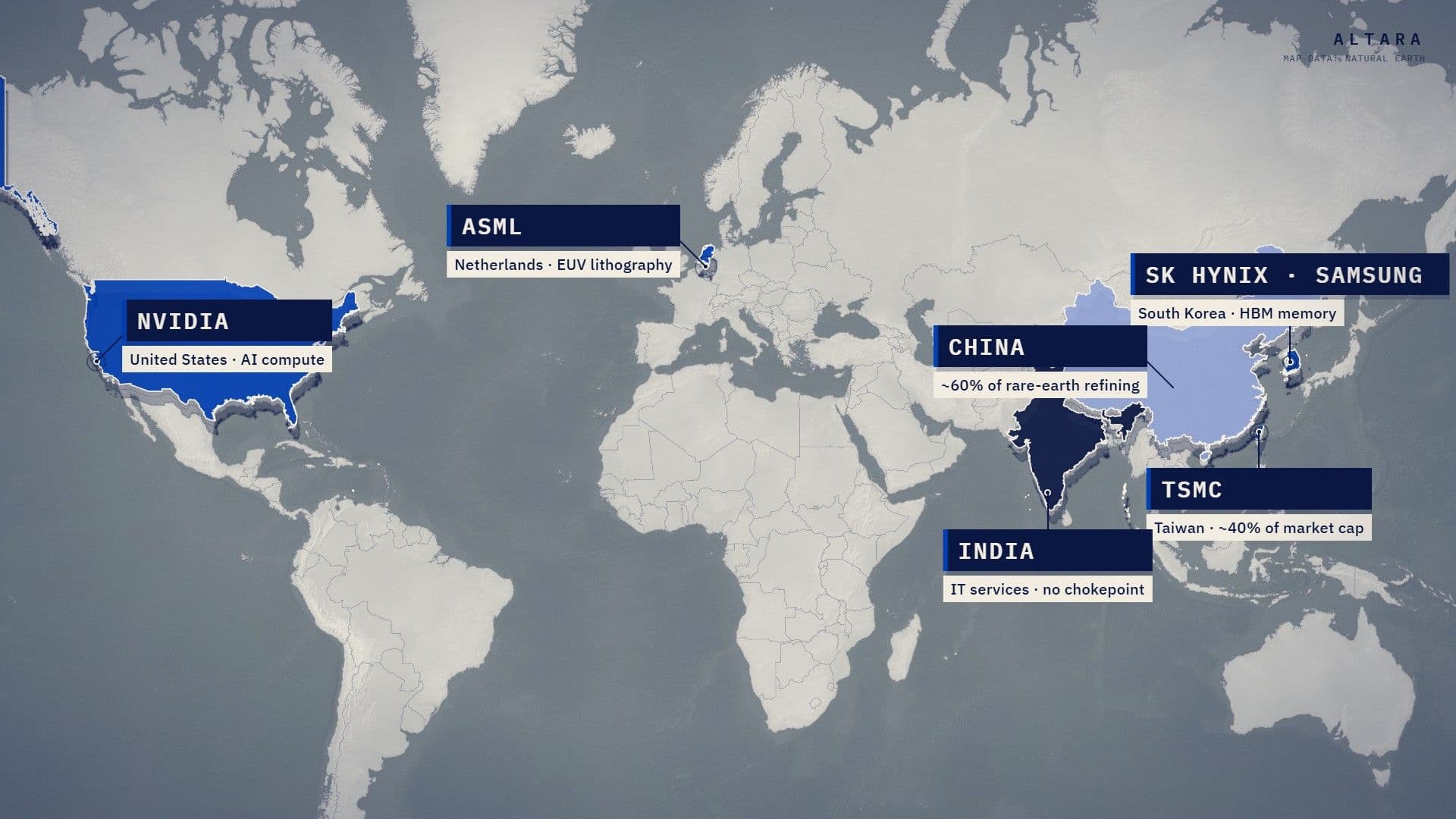
The Netherlands has 18 million people. ASML changes that calculation entirely. When Washington assembled the coalition to restrict advanced semiconductor exports to China, Dutch cooperation was operationally necessary, not diplomatically convenient. Without ASML's extreme ultraviolet lithography machines, leading-edge chip manufacturing is not possible regardless of capital or intent. One firm, occupying one chokepoint, gave a small country structural leverage over a major-power technology competition.
TSMC accounts for roughly 40 percent of Taiwan's total market capitalization. Nvidia controls the compute layer on which frontier AI training currently depends, a position the US Commerce Department has already converted into export policy. SK Hynix and Samsung together dominate high-bandwidth memory supply. China controls roughly 60 percent of global rare-earth refining capacity.
India does not hold a comparable position in any part of this supply chain. Its IT services sector is large and genuinely competitive. But a firm providing software services can be replaced by a lower-cost competitor. That is a different category of activity from operating the only facility capable of producing a particular class of components. It is about what happens to the system if you remove the firm.
The Limits of Bottleneck Power
Japan built the world's second-largest postwar economy without controlling a technology chokepoint in any sense comparable to TSMC. The European Union exercises regulatory reach far beyond its borders through market scale alone. Saudi Arabia's twentieth-century strategic importance derived from geology and geography. These are real forms of power, and any analysis that reduces influence entirely to bottleneck control is analytically imprecise.
The more defensible claim is narrower. Technological bottlenecks are growing in relative importance as the AI era concentrates economic value into a small number of structural positions, and they interact with other power sources in ways that amplify some and constrain others. A country with significant military capability but limited indigenous compute may find its defense modernization running through another country's export licensing regime. Bottleneck control does not make geography or demographics irrelevant. It changes what those assets can accomplish.
Why India Never Built One
The IT services model that produced TCS, Infosys, and Wipro was not an accident. It was a rational response to India's factor endowments in the 1990s: abundant English-speaking engineering talent, scarce capital, inadequate physical infrastructure for hardware manufacturing. The model worked, and because it worked, it shaped Indian technology's institutional and financial ecosystem around its logic.
That ecosystem is poorly suited to what building a strategic technology position requires. Deep-tech financing in India remains shallow relative to the bets involved. Taiwan's Industrial Technology Research Institute, established in 1973, was specifically designed to fund research that commercial capital would not touch on the required timescales. Samsung's early DRAM investment survived through the early 1990s partly because South Korean government policy absorbed losses that unassisted private capital would not have tolerated. India built no institutional equivalent. Whether this is a correctable gap or a structural path dependency is genuinely uncertain.
The Counterfactual, Measured in Incentives
Now consider what might happen if India was the essential actor when it came to technology between 2010 and 2020 instead of being forced into the economic role.
What mattered wasn't whether or not India would be richer. It was whose incentives would change as a result.
Would things have made any difference if India owned the infrastructure the other countries needed for the United States' coalition for export controls? Would China have had to factor in India's technology capabilities in their plan for supply chain security? How would the creators of GPT-4 and Gemini factor in the incentive changes knowing that India is home to one of the leading institutions?
Counterfactual India is not simply a richer country. It is a country whose absence from the negotiation affects the outcome.
How Success Would Actually Look Like
There is no requirement to build a TSMC in India. Nations do not need to experience the same sort of choke point. All that is needed are the correct strategic investments.
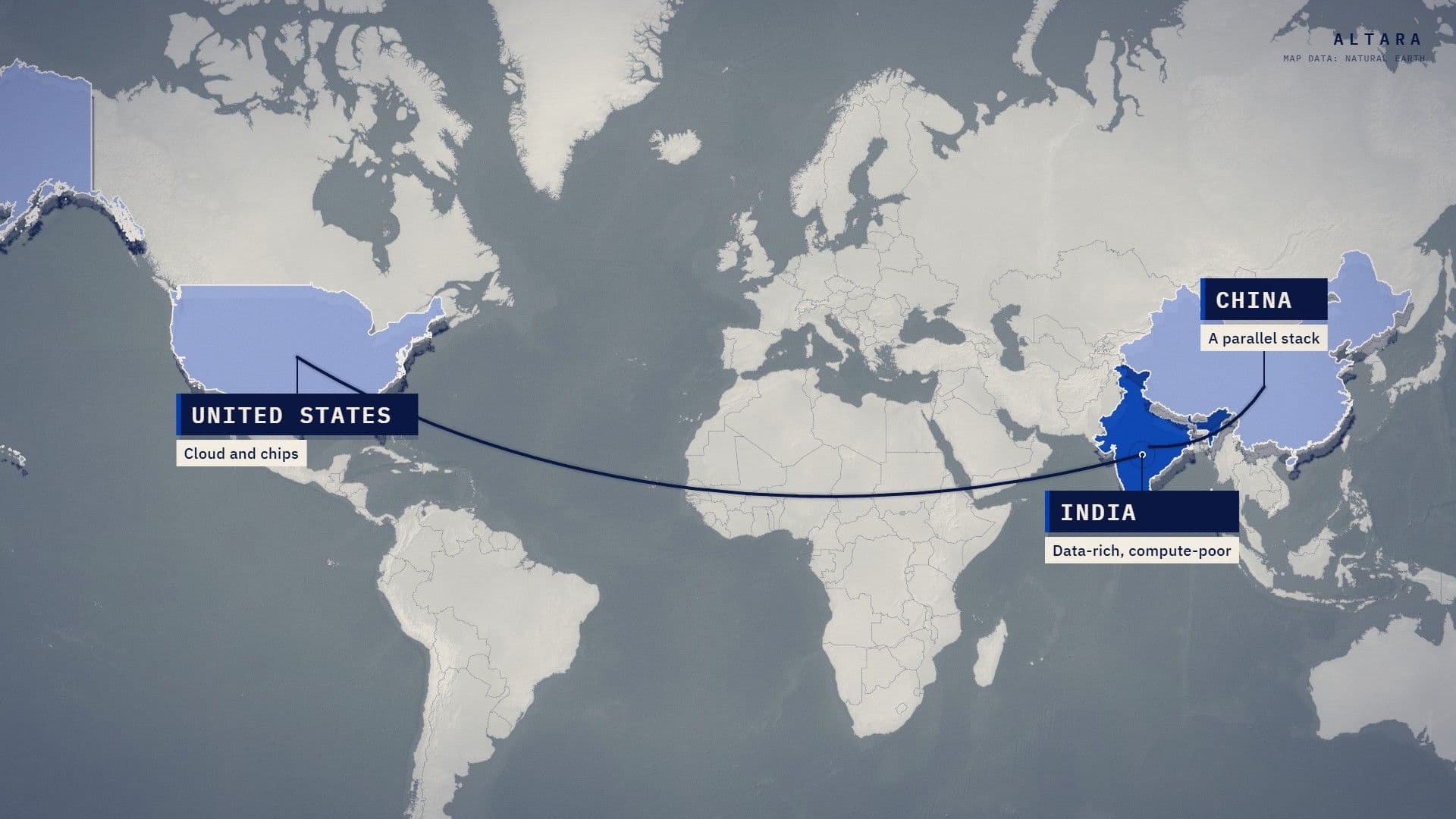
Such success can be achieved by building out the architecture of artificial intelligence in the Global South. There has been underinvestment in computing power and the training of AI models in areas beneath a certain level of economic development. Important digital architectures in the emerging world will serve as the basis for future decades, on which artificial intelligence will be increasingly reliant. If governments, businesses, and public services across emerging markets increasingly depend on Indian-built models and infrastructure, switching away becomes costly. At sufficient scale, those switching costs become leverage.
The Question of Whether the Window Stays Open
It is possible that this particular cycle of AI is generating structural advantages of a type that has traditionally been exceedingly hard to dislodge once created. The edge of TSMC isn't simply one of superior engineering at any given moment, but of approximately three and a half decades' worth of process knowledge gained that cannot be acquired through sheer financial outlay. To the extent that similar structural advantage is accruing from AI infrastructure, then timing becomes strategically important.
The Research deficit.
Technology is often treated as the starting point of strategic competition. It usually isn't. By the time a country produces a globally competitive semiconductor firm or aerospace company, decades of research have already happened in the background. Universities have trained the engineers, laboratories have produced new knowledge, and industry has found ways to turn that research into products. Technology is often the visible outcome of investments that began much earlier.
India has not invested at that scale. Gross Expenditure on Research and Development (GERD) has remained below one percent of GDP for years, well below countries such as China, South Korea, the United States and Israel. The problem is not simply that India spends less. Lower investment narrows the pipeline through which ideas become patents, startups and eventually globally competitive industries.
That matters because technological capability compounds over time. Countries rarely build advanced industries first and research ecosystems later. More often, it happens the other way around. Technology ecosystems are rarely built by industry alone. Universities supply the researchers, laboratories generate new knowledge, and sustained collaboration between academia and industry allows scientific breakthroughs to move beyond journals into commercial products. Silicon Valley grew alongside Stanford, South Korea's semiconductor industry benefited from institutions such as KAIST, and China's technological rise has been closely linked to heavy investment in research universities. Higher education therefore does far more than produce graduates; it shapes a country's long-term innovation capacity.
The strength of a country's universities and scientific institutions eventually shapes the technologies it is capable of producing, and those technologies go on to shape its economic and strategic position.
The Broader Issue
What Kennedy argues is that great powers fall apart because the bases of their economic and technological power decay at a quicker rate than their strategic commitments diminish.
Ultimately, this is not only a story about semiconductors or artificial intelligence. It is about the foundations of national power. Capital follows innovation, innovation depends on research, and research is sustained through long-term investment in science, higher education and technology. Countries that build these foundations gradually become difficult to ignore, not because of their size alone but because the international system begins to depend on them. For India, the challenge is therefore larger than building a successful technology sector. It is about building the scientific and technological depth that allows economic strength to translate into lasting strategic influence power.
Next week’s paper, in your inbox
More research

Strategic Stability · Horizon 2026–2030
Borders Are Fixed, But Threats Aren’t
Rethinking the Meaning of Security
Geoeconomics & Supply Chains · Horizon 2035 and beyond
Computing Power
Data Centres as the New Battlefield of Great Power Competition